Health technology · AI/XR strategy
From early proposition to an executable AI/XR product programme
Spencer served as CTO, defined the product architecture and 24-month roadmap, prioritised prototype development and provided technical direction across a 12+ person multidisciplinary programme.
Overview
When Spencer joined NURA XR, the business had a founder and an early proposition. As CTO, he translated that ambition into product architecture, a 24-month roadmap, prioritised prototype development and technical direction across a multidisciplinary team of more than 12 people.
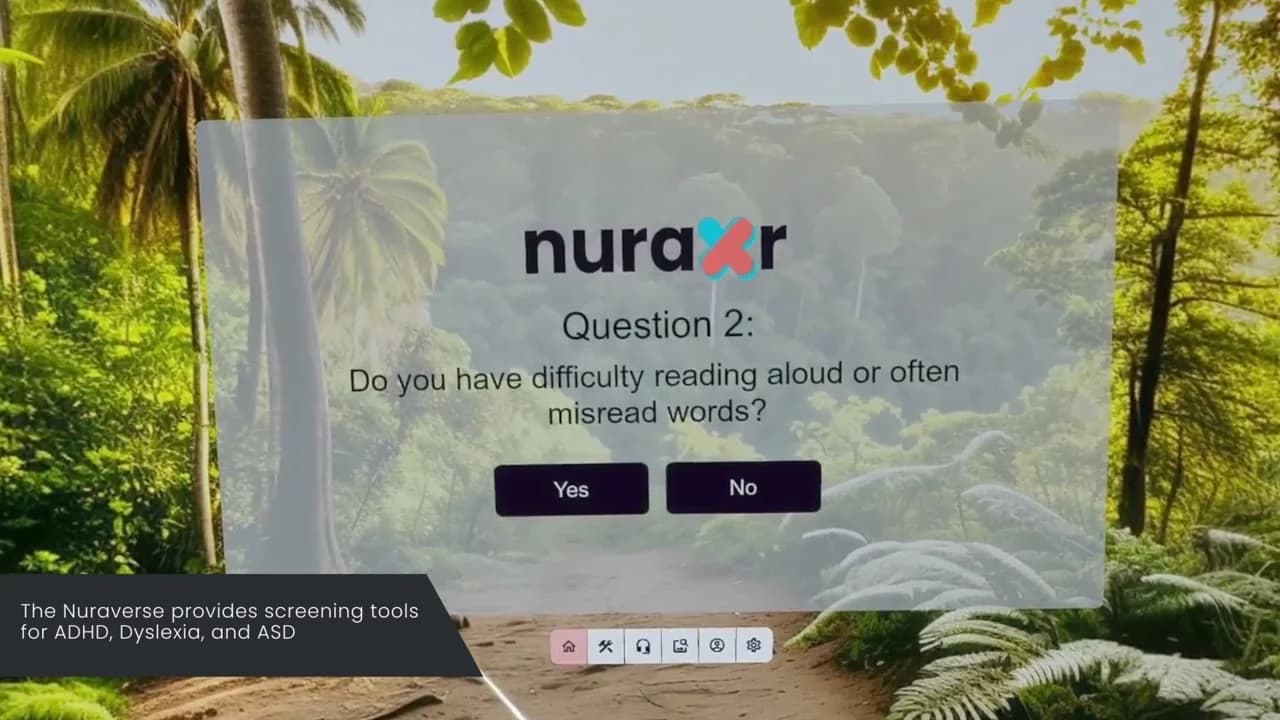
Project media
NuraVerse proof of concept
Silent proof-of-concept highlights only. They show prototype functionality, not clinical validation, diagnosis or completed formal trials.
A founder and an early AI/XR proposition.
A 12+ person multidisciplinary programme with product architecture, a 24-month roadmap, multiple working prototypes, early neurodivergent-user feedback and a pathway towards formal trials.
From founder proposition to programme
When Spencer joined, NURA XR had a founder and an early proposition. He framed the product problem, created an architecture and 24-month roadmap, prioritised development and turned the ambition into an executable R&D programme.
Product and technology leadership
As CTO, Spencer provided technical direction across a multidisciplinary programme of more than 12 people. A ten-person product and engineering function sat within that wider programme.
Multiple working prototypes
By his departure, the programme had functioning prototypes spanning AI-assisted screening and profiling, adaptive XR learning and support, conversational AI, executive-function tools and early eye-tracking data gathering to support future ML work.
Feedback before formal trials
More than 200 people saw or used demonstrations at events. Approximately 40–50 neurodivergent users with dyslexia, ADHD and/or autism tried prototypes and provided useful feedback. This was prototype exposure and feedback, not clinical validation.
A responsible path towards trials
Spencer worked with specialist advisers including an educational psychologist and an NHS GP while the programme moved towards more formal trial preparation. Privacy, security, consent and governance boundaries were considered alongside delivery; no NHS deployment or completed formal trial is claimed.
Outcome
More than 200 people saw or used demonstrations, including approximately 40–50 neurodivergent users with dyslexia, ADHD and/or autism who tried prototypes and provided useful feedback. The programme was preparing for more formal trials; no clinical validation or completed formal trial is claimed.
Technology & methods
- AI/XR architecture
- Product roadmap
- Privacy by design
- Multidisciplinary technical direction
Credibility indicators
- Multiple functioning prototypes
- Early neurodivergent-user feedback
- Preparation for more formal trials
Related capability
- AI strategy
- Technology strategy
- Product leadership