Energy · Digital twin
A structured route from complex brief to accepted delivery
As Founder and Director of Immersible, Spencer led discovery, requirements, commercial scope and the Statement of Work, then governed change, client reviews, testing, acceptance and handover.
Overview
SEaB Energy’s Flexibuster is a large, containerised food-waste system that produces useful energy, including electricity, and fertiliser. Its scale and complexity made it difficult to take the product to prospects or use the live equipment for repeatable technical training.
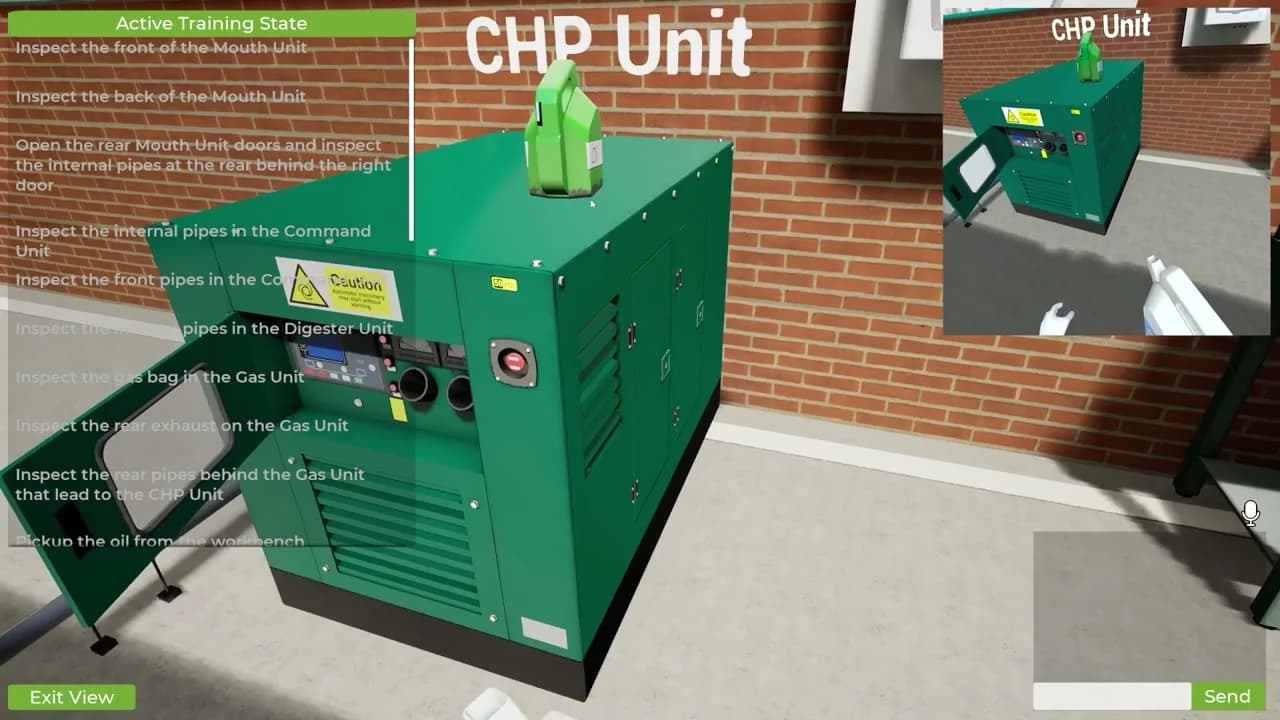
Project media
Flexibuster Digital Twin — PC and VR
A silent highlights edit showing the model, guided tasks and equipment views used to explain the system.
A physical product that could not travel easily
The Flexibuster is a large containerised system for processing food waste into useful energy, electricity and fertiliser. Moving it simply to support a sales conversation was impractical, especially when prospects and stakeholders were distributed internationally.
Taking the product to prospects
The first need was commercial: enable large groups of remote prospects and stakeholders to explore the system at useful scale, understand how it worked and ask informed questions without being beside the physical installation.
Training without operational risk
The second need was technical. Engineers needed a safe setting in which to inspect internal components, understand operating sequences and practise maintenance or fault-diagnosis scenarios without damaging equipment, interrupting operation or creating danger.
Discovery before technology
Spencer led discovery and client workshops to define these as distinct but connected use cases. He translated the commercial, user and technical needs into solution options that could be assessed for feasibility, value and delivery risk.
Shaping a usable digital experience
The scope centred on a near-real-life, to-scale digital twin with interactive controls and shared scenarios. It was designed for relevant device contexts so the experience could support both accessible desktop use and more immersive VR interaction.
A conventional delivery lifecycle
Spencer led requirements and commercial scope, produced the Statement of Work, managed change control and coordinated the technical team. Fortnightly demonstrations and reviews kept decisions visible throughout the nine-month project.
Acceptance and handover
Spencer led review and testing through to client acceptance and handover. The completed PC/VR application met the agreed specification and was used for sales demonstrations, service-engineer and maintenance training, remote familiarisation and realistic interaction with the machine.
Outcome
The final application was completed to specification, delivered on time and on budget, and used for its intended sales-demonstration and training purposes.
Technology & methods
- Digital twin
- Multi-modal access
- Client discovery
- Statement of Work and change control
Credibility indicators
- Completed to specification
- Client-corroborated on-time and on-budget delivery
- Acceptance and handover led by Spencer
Related capability
- Technology strategy
- Consulting
- Delivery governance